

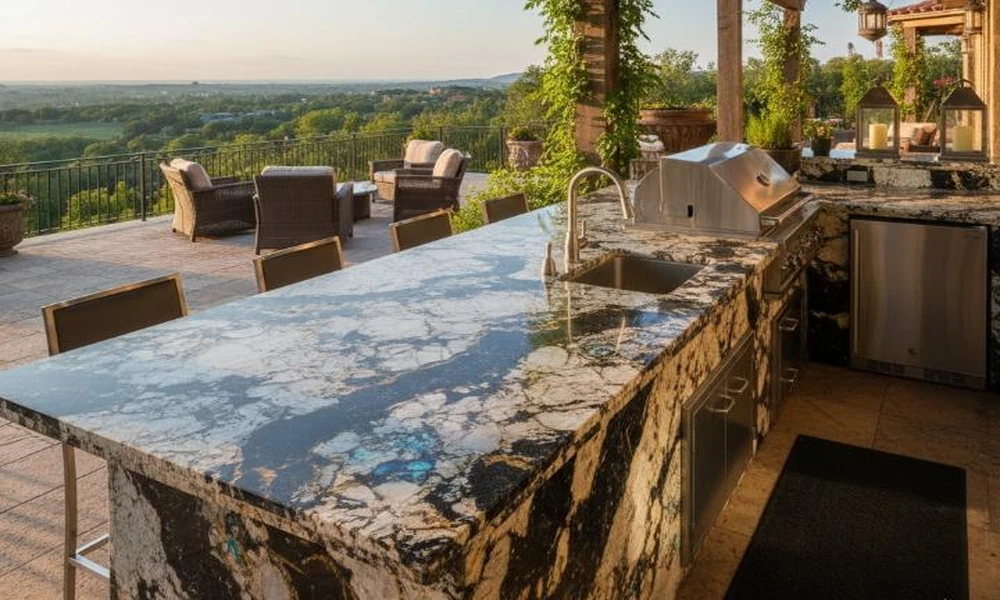
Two slabs from the same quarry can look like cousins and behave like strangers. That’s the part nobody warns you about. You walk into a yard, fall for the slab with the wild gold veining, sign the work order, and then spend the next decade staring at a seam running straight through the prettiest part of the stone.
The fix isn’t more research. It’s knowing what to look at, in what order, and with the lights on. When you’re comparing options for granite kitchen countertops, the decision that matters most isn’t color. It’s how one specific slab will meet your cabinets, your window, and your sink cutout. Get that right and the color choice almost makes itself.
Below is the selection method I’d use if I were buying tomorrow: a slab-first approach that treats the stone as the starting point and the kitchen as the constraint.
Why the slab yard beats the showroom
Showroom samples are chips. Slabs are acres. A six-inch square tells you the color palette and nothing about movement, so the pattern you’ll actually live with is invisible until you see the full piece lying flat.
Book a slab yard visit and bring three things: a cabinet door, a paint chip, and your phone with the flash off. Set the door against the edge of the slab and step back eight feet. That’s roughly how far you’ll stand when you’re cooking, and it’s the distance where busy stone either reads as texture or as noise. Most buyers never do this. They lean in, study the details, and buy a slab that fights their kitchen from across the room.
One more thing worth knowing about the material itself: granite is an igneous rock formed from cooled magma, which is why no two pieces share a pattern. The U.S. Geological Survey documents the mineral makeup of these rocks, and that variation is the whole appeal. You’re not picking a color from a catalog. You’re picking one physical object that exists once.
The five-foot rule, and other habits that save you later
I call this the Kitchen Sightline Method, and it’s three passes over the same slab. Fabricators won’t charge you for it, but it’s the difference between a counter you love at year one and a counter you tolerate at year six.
- Pass one, standing. Look at the slab from where your kitchen entry sits. Note where the dramatic veins fall. If the best movement lands in a corner where a wall hides it, you’ve paid for a feature no one sees.
- Pass two, sitting. Pull up a stool at counter height. This is where your eye rests while you eat breakfast, so check whether the pattern at that level feels calm or chaotic.
- Pass three, at night. Ask to see the slab under warm lighting, since cool daylight in a yard flatters stone that can look flat and gray above your under-cabinet bulbs.
Each pass takes seconds, and together they catch the mistakes that cost the most: seams through focal veins, a slab too busy for an already patterned backsplash, and pattern that disappears where the light dies.
Seams, cutouts, and the layout conversation
Every countertop has a layout drawing before anyone cuts. Ask to see yours. The fabricator decides where seams land and where the sink and cooktop cutouts go, and those decisions are permanent once the blade drops.
Two rules I’d hold firm on. First, keep seams out of the sink run if the slab allows it, because a seam near the sink lives with water and gets scrutinized every day. Second, place the sink so the most interesting part of the slab stays visible on the working side, not behind the faucet. Also check the material’s flexural strength, a measure of how a stone handles bending stress, since the National Institute of Standards and Technology publishes testing standards that fabricators reference for natural stone. Ask yours which spec they work from, and watch how they answer.
If a seam has to exist, ask for it to fall where the stone’s pattern already breaks. A seam through a calm field reads like a quiet line. A seam through the center of a bold swirl reads like a mistake.
Slab thickness, overhang, and edge profile: what actually matters
These three get treated as style choices. Two of them are structural.
| Decision | What it affects | My pick |
|---|---|---|
| Thickness | Support at overhangs, visual weight | Standard thickness with hidden support brackets, not a chunkier slab |
| Overhang | How much seating your island gives you | Enough for knees, with brackets underneath |
| Edge profile | How the counter meets your hand | A simple eased edge that won’t trap crumbs |
Ornate edges were a trend that overstayed. They collect dust in the grooves and date a kitchen faster than any granite pattern ever will. Skip them.
Is any of this about maintenance, or just looks?
Mostly looks, honestly. Granite holds up to daily life without much fuss, and sealing is a once-a-year habit rather than a weekly chore. A kitchen that runs hot and wet, with pans straight off the burner and spills wiped in seconds, suits stone far better than a material you have to baby. The Environmental Protection Agency has general guidance on indoor air and building materials if you want to understand what’s in your home, and natural stone is about as inert as surfaces get.
What isn’t about looks is resale. Buyers run their hands along a counter, and stone tends to answer that question without your help.
Your pre-purchase checklist
- Bring a cabinet door to the slab yard, not a photo.
- Run all three passes of the Kitchen Sightline Method before you commit.
- Ask for the layout drawing and read the seam plan out loud.
- Confirm lighting temperature in the room where the slab will live.
- Choose the simplest edge profile you can live with.
Five steps. Maybe forty minutes. That’s a cheap trade for a surface you’ll look at every morning for the next twenty years.
What to do before you sign anything
The right slab isn’t the one with the most dramatic veining or the best price tag. It’s the one whose pattern holds up from your doorway, in your lighting, with your seams planned around its focal points. Everything else is preference.
So here’s the question worth sitting with: if you stood in your kitchen right now and looked at the counter from the spot you use most, what would you want to see? Start there, and the slab yard visit stops being overwhelming. It becomes a short list.