

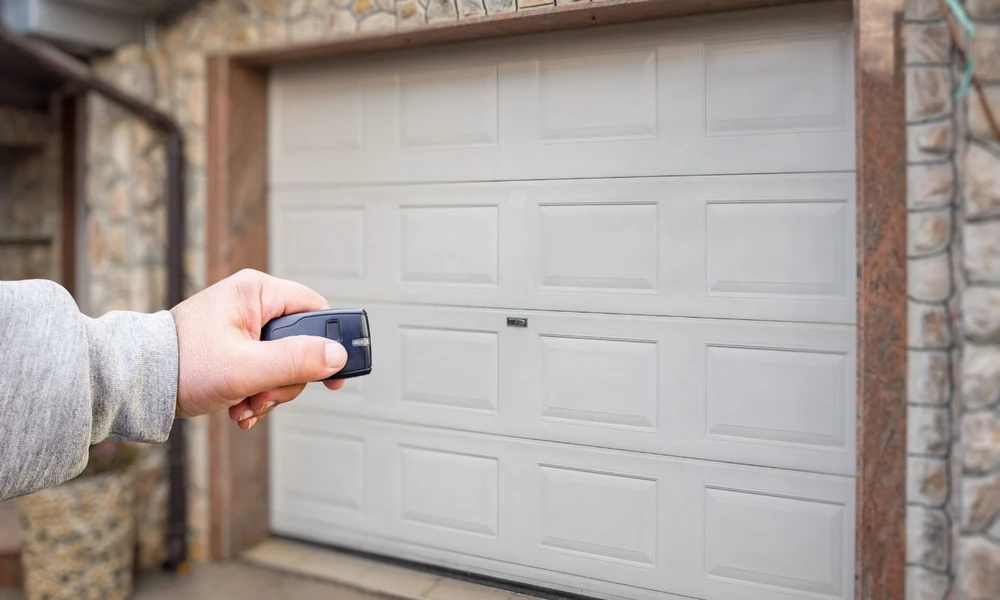
Your garage door opener will probably give out somewhere between year 10 and year 15, and most homeowners ignore the warning signs until the door slams shut on a Tuesday morning. That’s the bad news. The good news is that replacement costs a fraction of what people expect, and the new units are dramatically quieter and smarter than anything built a decade ago. Here’s the honest breakdown of how long these machines actually run, which failures are worth fixing, and when you should just pull the trigger on a new unit.
What the Average Lifespan Really Looks Like
Manufacturers rate most residential openers for roughly 10,000 to 15,000 open-and-close cycles. Run through the math on a typical two-car household: you open and close the door about 3 to 5 times a day, which means 1,100 to 1,800 cycles per year. At that pace, the motor hits its rated life somewhere between 6 and 14 years, depending on how heavy your door is and how often you actually use it.
Daily-use patterns shift the numbers more than anything else. A family that parks two cars, uses the garage as the main entry, and runs errands constantly might hit 8 open-close cycles a day. That same family could burn through an opener in under a decade. A single person who opens the door twice a week? That opener can easily last 20 years. The unit doesn’t care about age, it cares about revolutions on the motor shaft.
Here’s the part most people miss: the opener rarely dies of old age. It dies because the spring system fails first, and a broken spring puts massive strain on the motor. According to the Bureau of Labor Statistics housing data published in 2023, the median American home is now 40 years old, which means the garage door opener is often the third or fourth one installed in that same house. The frame and tracks are old, the springs are tired, and the opener is doing the work of lifting a door that’s heavier than it was when new.
The Warning Signs That Signal the End
You don’t need a technician to tell you the unit is failing. The signs are obvious once you know what to listen for.
- Grinding or rattling noises during travel usually mean worn gears, and gear replacement costs nearly as much as a new unit.
- Intermittent response to the remote or wall button often points to a dying logic board, not a dead battery.
- The door reverses direction for no reason, which means the safety sensors are failing or the force adjustment is maxed out.
- Visible shaking of the motor housing during operation signals worn chain or belt components.
One specific scenario tells you everything. If the door opens fine manually but struggles with the opener attached, the motor is losing torque. That’s not a simple fix, it’s mechanical wear that only gets worse. And here’s the thing: a failing opener doesn’t just inconvenience you, it becomes a safety issue when the door starts slamming or reversing unpredictably.
Repair or Replace: The Honest Cost Math
Let’s talk dollars because that’s what actually drives the decision. A service call plus parts for a mid-range opener repair, things like limit switch replacements, capacitor swaps, or sensor realignment, typically lands between $100 and $250. That’s a reasonable fix for a unit under 8 years old with no other problems.
But here’s where the math flips. Once you cross the 10-year mark, the probability of a second failure within 12 months climbs fast. The motor bearings wear, the circuit board components degrade, and the plastic gears lose their tolerance. You’ll pay $150 to fix the limit switch in March and then $200 for a sensor failure in September. You’re now $350 into a machine worth maybe $100 used.
New residential openers run $150 for a basic chain drive up to $500 for a belt drive with battery backup and Wi-Fi. That’s a replacement cost that includes professional garage door opener installation in Atlanta and other markets, and it comes with a fresh warranty. My rule of thumb? If the opener is older than 10 years and needs anything beyond a sensor adjustment or remote reprogramming, replace it. You’re buying time, not a solution.
What Changes With a Modern Replacement
People resist replacement because they assume the new unit works exactly like the old one. That assumption is wrong, and it’s costing you convenience every day you delay.
Modern openers run on DC motors instead of AC, which means they’re dramatically quieter. The difference is startling. The old chain drive sounds like a small engine turning over. A new belt drive unit sounds like a whisper. If your garage sits under a bedroom, that’s a quality-of-life upgrade you’ll feel at 6 AM.
Battery backup is the quiet hero feature. When the power goes out, most people realize their garage door is a massive steel slab they can’t move. Units with integrated battery backup keep working for up to 20 full cycles during an outage. The U.S. Department of Energy reported in its 2024 appliance efficiency data that garage door openers now account for up to 1,440 kilowatt-hours of household energy consumption annually in homes with heavy usage, and the newer DC motor units draw roughly a third of the power of older AC models. That’s a real line-item change on your electric bill, small but real.
Smart connectivity is where the experience fundamentally shifts. You can open the door from your phone, get push notifications when the door opens, and set schedules so the door closes every night at 10 PM. Parents with teenagers will feel that last feature in their bones.
The 4-Step Replacement Decision Framework
When you’re staring at a dead or dying opener, use this framework instead of guessing. It’s the same process I walk through with anyone who asks, and it filters out the noise.
- Check the age sticker. Openers have a manufacture date on the side label. If it’s older than 12 years, skip all further diagnostics. Replace.
- Isolate the failure. If the door opens manually but not with the motor, the issue is the opener, not the door. If the door binds when you lift it by hand, the springs or tracks are the problem and no opener will fix it.
- Count the repair cost against 30% of new. If the quote is more than a third of the price of a new unit, replacement wins on economics alone.
- Check the warranty period. A repair on a unit out of warranty gives you zero protection. A new unit backs you with parts and labor coverage for years.
Run those four filters and the decision makes itself. I’ve never once seen the math favor repairing a 15-year-old chain drive with a burned-out circuit board.
One more consideration that rarely gets discussed: the age of your garage door itself. If your door is pushing 20 years old and the opener just died, you might be replacing both within a year anyway. Weigh whether a combined project makes more sense than two separate service calls.
When the Upgrade Isn’t Worth It
Not every situation calls for a top-tier unit. If you’re in a rental property, a temporary home, or a garage you rarely use, the basic $150 chain drive is perfectly fine. It’s loud, sure, but it’s cheap and reliable.
The belt drive and smart features earn their premium only when you actually use them. If your garage is a glorified storage unit and you open the door twice a month, paying $350 extra for app controls is wasted money. Spend the difference on a good set of torsion springs instead, since those are the real workhorse of the system.
So how long does your opener have left? If you installed it before Obama’s first term, the honest answer is not long. The good news is that replacements have never been cheaper, quieter, or more capable, and most installations finish in a single visit. The question isn’t whether you’ll replace it. It’s whether you’ll make that call yourself, or wait for the 7 AM failure to make it for you.