

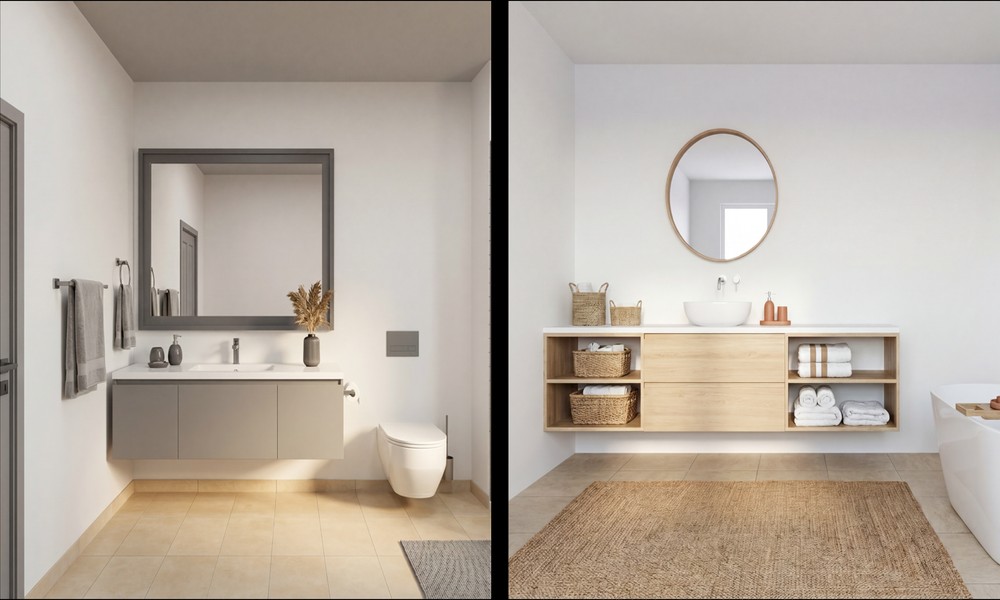
Every project in interiors starts with the same artifact: a floor plan or a room photo that only a specialist can really read. Lines, labels, and dimensions mean something to architects and designers, but for clients, homeowners, and buyers, they are little more than guesswork. VirtualSpaces was built to close that gap – turning flat inputs into photoreal, navigable 3D environments in minutes, not weeks.
What began as tools for interior design and home renovation has grown into something larger: a spec-accurate world-building engine that reads real drawings, constructs precise geometry, furnishes with AI, and streams the result in a browser. That engine now powers Foursite and Remodroom today, and is evolving into an infrastructure layer for how people design, sell, and experience real spaces online.
What’s Already Built
Foursite converts 2D floor plans and architectural blueprints into fully modeled 3D interiors – walls, doors, windows, and room types recognized automatically by the AI. Designers and homeowners upload a JPG or PNG of a plan, and within minutes they can walk through the resulting space in a real-time 3D viewer, generating photorealistic renders from any point of view with a single click, without touching traditional 3D or CAD software.
Remodroom works from the other direction. Instead of a floor plan, it starts from a single room photograph and turns it into a fully redesigned, photorealistic interior image. The system reads the existing furniture, flooring, wall finishes, and lighting, then lets users swap pieces, change styles, and re-light the space while preserving realism. The output looks like a professional photograph of a completed project, ready to send to a client, contractor, or listing – no manual masking required.
Why 2D to 3D Was a Hard Problem
“Read a floor plan and extrude it into 3D” sounds simple. In practice, floor plans are one of the hardest inputs in computer vision – dense, stylized, often low-quality scans where lines, symbols, text, and scale all overlap. Off-the-shelf models treat them as noisy clip art, struggling with basic questions like which lines are walls and which annotations belong to which room.
VirtualSpaces built an end-to-end pipeline that handles real-world constraints. The system pre-processes each floor plan to normalize orientation, scale, and clarity, then passes it through an AI intelligence layer that performs feature extraction, semantic segmentation for room types, and dimension extraction. That combination yields enough structure to construct a scene graph – a machine-readable map of what exists where and how spaces are connected. The result: a pipeline that goes from flat plan to navigable 3D package in under two minutes, without manual modeling or GPU-heavy desktop software.
The Spec-Accurate Engine Under the Hood
The core idea is simple but powerful: treat architectural drawings as structured specifications, not just images. Instead of estimating geometry from pixels alone, the system uses OCR and natural language processing to read the room names, dimensions, and area labels that architects have already written into the drawing. Those values become the ground truth for room sizes, adjacencies, and proportions.
On top of that geometry, VirtualSpaces layers its photorealistic graphics pipeline. Screen Space Global Illumination (SSGI) and Screen Space Reflections simulate how light actually behaves inside interiors, while PBR materials and high-resolution textures give surfaces the subtle variation of real wood, stone, and fabric. All of this runs in a browser-native WebGL engine with automatic lighting – no specialist software required.
What’s Coming Next
The engine is not static. Incoming capabilities include AI Furnishing – where designers drop simple 3D furniture placeholders directly into the floor plan and the AI generates high-fidelity interior visuals based on those placements. First-person and orbital views will be first-class modes, letting users toggle between an axonometric technical perspective and an immersive walkthrough with adjustable camera height and field of view.
Real-time shareable links will make distribution as simple as sending a URL: any space built in Foursite can be shared without logins, and as a design evolves, viewers always see the latest version. A dynamic floor plan editor with precision controls will let users make structural changes directly in the browser – moving walls, inserting openings, adjusting heights – with floor-to-ceiling and window-sill heights becoming sliders instead of hours in a modeling package.
Why This Matters for Design, Sales, and Retail
A project rarely stalls because of a lack of mood boards; it stalls because clients and buyers cannot see themselves in the proposed space. They don’t know whether the sofa will actually fit, whether the dining table will feel cramped, or whether the wardrobe will block natural light. The result is hesitation, slow approvals, and – in retail – expensive returns.
For online furniture and home goods, this shift is especially important. A customer often sees a beautiful product shot that bears little resemblance to their real apartment. By anchoring the visual experience in the customer’s own floor plan or photo, the engine turns products into context-aware objects that can be placed, rearranged, and approved in seconds. That is not just better UX; it is a structural advantage in conversion rate and return reduction.
Beyond a Single Use Case
Because the engine is built around real-world floor plans and spec data, its usefulness extends beyond any single industry. Property portals can embed it to let buyers step through floor plans before a site visit. Furniture brands can plug it into their product pages. And any workflow that depends on “from drawing to believable 3D space” can sit on top of the same pipeline – accessible via the VirtualSpaces REST API and SDK layer as a native capability.
The goal is grounded: make the path from intent to a trustworthy visual incredibly short, and make that path available to anyone working with residential spaces. When a homeowner uploads a plan, they should see a believable version of their future home within minutes. When a furniture brand launches a new collection, customers should be able to see it inside their own rooms on day one. The engine to make that happen is already being built.