

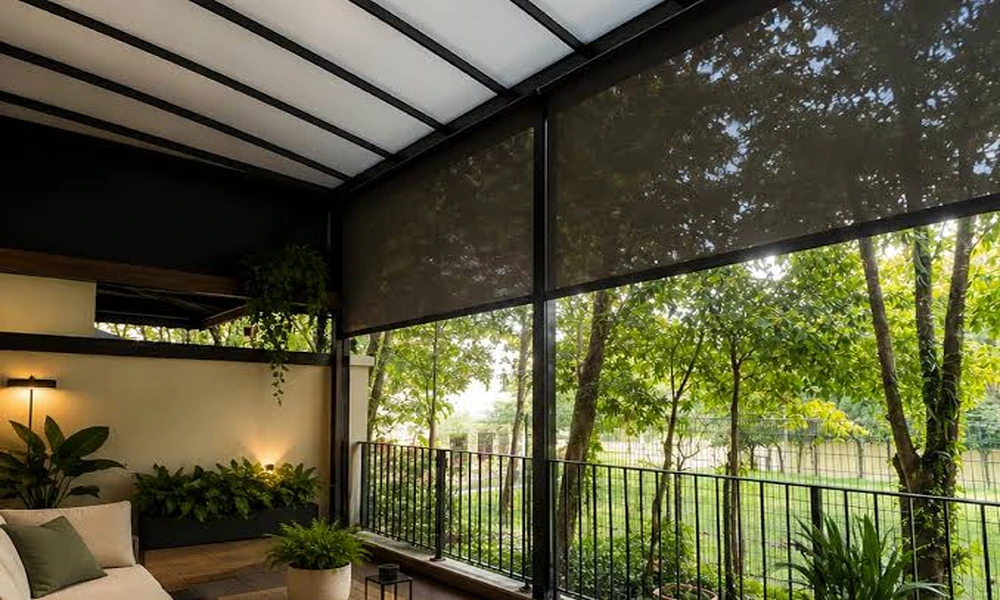
At two o’clock on a December afternoon the balcony of a twelfth-floor flat is bright, still and hot. By half past three it will be lashed by rain, and by five it will be steaming gently in low sun. Few spaces in a home face such swings in a single afternoon. Watching how outdoor blinds for balcony cope with each phase, one after another, tells an owner far more than a product list of fabrics and brackets.
Two O’Clock: Glare on the Tiles
The sun is high and slightly behind the block opposite. Light bounces off pale floor tiles into the living room. With a mesh screen lowered halfway, the glare falls sharply while air still drifts through the weave. From inside, the skyline remains visible as through tinted glass. This is the shade function at its simplest. The openness of the mesh decides the balance: a tighter weave gives more shade and less view, a looser one the reverse.
Half Past Two: The Neighbour Hangs Washing
Across the gap, someone steps out with a laundry pole and glances over. The lowered mesh does its second job. In daylight, the brighter side cannot easily see into the dimmer side, so the family on the sofa is screened without sitting behind a solid wall. A deeper colour improves this effect and the outward view. The limit is worth stating plainly: once lamps are lit indoors at night, the advantage switches sides.
Three O’Clock: The First Gust
The air shifts. Leaves spin in the car park and the hanging plants swing. A blind held only by its own bottom weight would now be lifting and slapping the railing. This one runs in channels at both edges, the fabric locked into the tracks along its full height, so it stays flat and quiet. On an upper floor this single feature separates a screen that can be left down from one that must be rescued before every squall.
Quarter Past Three: Lowering the Lot
The sky turns the colour of slate. The owner presses a wall switch and the screens descend to the parapet, the bottom bar settling onto its seal. Had the system been crank-operated, this would be two minutes of winding per bay, which is why wide balconies tend to be motorised. Anyone comparing weatherproof balcony screen options should time this step in a showroom, since a blind that is tedious to lower is usually found half-open when the rain arrives.
Half Past Three: Rain Arrives Sideways
The downpour comes at a slant, driven by wind. Here the choice of material shows. A clear or tinted PVC panel turns the balcony into a dry room; water sheets down the outside. A mesh screen breaks the force of the rain and keeps the bulk of it out, though a fine mist may still drift through the weave in the strongest gusts. Households with timber furniture or electronics outside lean towards PVC or a mixed arrangement.
Four O’Clock: Warm, Wet and Shut In
With everything sealed, a drawback appears. Solid panels stop air as well as water. The balcony grows humid, and if the sliding doors are open the dampness creeps indoors. Mesh breathes and avoids this. A common compromise is PVC on the side that takes the weather and mesh elsewhere, or raising one bay slightly once the worst has passed. Ventilation deserves as much thought at the planning stage as waterproofing does.
Half Past Four: The Storm Moves Off
The rain thins. Before raising anything, the owner waits for the fabric to dry or wipes it down with a soft cloth. Rolling a wet, gritty blind into its cassette traps moisture and dirt against the material, which leads to mildew spots on mesh and scratches or cloudiness on PVC. This small habit, repeated after each storm, has more influence on how long the screens last than almost any specification chosen at purchase.
Five O’Clock: Low Sun From the West
Now the light comes in flat and orange, straight through the balcony into the living room. Screens that were lowered for rain stay down for heat. Shading the glass doors from outside, before sunlight reaches them, is more effective than drawing curtains inside. The room behind stays noticeably more comfortable, and the air-conditioner has less to do. The same screens have now served as sunshade, privacy veil, windbreak, raincoat and sunshade again.
The Hour Nobody Photographs: Getting Permission
One part of the story happened months earlier. A balcony belongs to the face of the building, and estates control what appears there. In public housing, HDB sets conditions on balcony installations; in private developments the management corporation often specifies permitted screen types, colours and fixing methods. This owner obtained written consent from the MCST before ordering. Skipping that step risks an instruction to remove everything at one’s own cost.
Choosing for Your Own Afternoon
Stand on your balcony on a blustery day and note which side the weather strikes, where the sun sets and who overlooks you. Those three observations decide between mesh, PVC or a mixture, and whether guided edges and a motor are necessary. Confirm the estate’s rules, ask for a site measurement, and see a full-size sample operated. Chosen against real afternoons like this one, outdoor blinds for balcony earn their keep on the days that matter.