

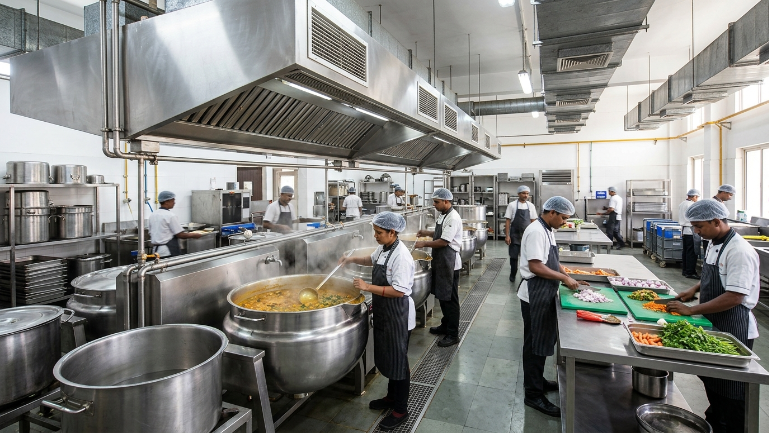
A canteen inside an industrial estate is a food business with an unusually predictable customer base and an unusually inflexible one. Everyone eats within the same ninety minutes, almost nobody comes at the weekend, and the whole trade disappears if the anchor tenant relocates. Anyone considering an industrial canteen for rent is buying access to a captive population, and the value of that access depends entirely on how large and how permanent the population is.
Understand the Catchment Precisely
Do the arithmetic before anything else. How many people work in the building and in the immediately adjacent ones? What proportion are on site daily rather than in the field? What shift patterns do they work, and is there evening or night demand? How many alternatives are within a five-minute walk, including other canteens, coffee shops and delivery? A canteen serving eight hundred workers with no nearby alternative is a different business from one serving two hundred with a food centre across the road.
The Peak Is the Whole Operation
Industrial canteens live or die on throughput during a narrow window. If most of the site breaks between twelve and one, the kitchen must produce and serve at a rate that empties the queue within that hour, because workers who cannot be served in time will not return tomorrow. This drives everything: menu design toward items that can be pre-prepared and portioned quickly, servery layout, the number of service points, seating turnover, and staffing levels that are unavoidably peaked.
Check What the Tenancy Actually Permits
Premises within an industrial estate carry conditions on use, and a food operation involves more of them than most. Confirm that food and beverage use is permitted in the specific unit, what hours operation is allowed, whether you may serve people from outside the estate or only its occupants, and whether any exclusivity applies. Establish who your landlord actually is, since canteen space is frequently sublet from an anchor lessee rather than taken directly, and their rights determine what can be approved.
Licensing and Regulatory Requirements
A food establishment requires the appropriate licence, and premises must meet requirements covering layout, food preparation areas, washing facilities, ventilation, grease management and pest control. Food handlers require the relevant training and registration. If the premises have not previously been used for food, converting them may involve substantial works and approvals, including drainage, grease traps and mechanical ventilation. Establish the position before signing, since a unit that cannot be licensed is worthless whatever the rent.
Infrastructure Costs More Than the Rent
Kitchen fit-out is capital-intensive, extraction and ventilation, grease traps, adequate electrical supply, gas where used, water supply and drainage, cold storage, and the equipment itself. Confirm what exists, what condition it is in, and what the electrical capacity actually is, since kitchen equipment draws heavily and an inadequate supply is expensive to upgrade. Advisers on renting industrial premises should be checking these before rent is even discussed.
Waste, Grease and Pest Control
Food operations generate waste streams that industrial landlords care about. Establish how food waste is stored and collected, how often, and where the bin area is relative to your unit and to other tenants. Grease trap maintenance is a recurring obligation and neglecting it produces both blockages and complaints. Pest control is a licensing matter as much as a hygiene one, and in an estate setting a problem originating in your unit becomes everyone’s problem quickly.
Pricing for This Customer
Industrial canteen pricing is constrained in a way restaurant pricing is not. The customers are the same people every day, they compare prices against the coffee shop down the road rather than against a food court in town, and there is a ceiling above which they will simply walk further or bring lunch. Some tenancies impose price conditions directly, particularly where the anchor employer wants affordable meals for staff, so check whether any such requirement forms part of the agreement. Within those limits, the levers are portion control, menu engineering toward items with better margins, and buying discipline, rather than headline price increases.
Tenure Length Against Fit-Out Investment
The single most important commercial question is whether the term is long enough to recover the fit-out. A substantial kitchen investment against a two-year tenancy with no renewal right is a poor risk, particularly when the equipment is difficult to remove and worth little second-hand. Negotiate a term proportionate to the capital involved, seek an option to renew with a defined rent mechanism, and establish the reinstatement obligation, since stripping out a kitchen is itself a significant cost.
The Anchor Tenant Risk
The defining vulnerability of this business is dependence on a small number of employers. If the main occupier of the building relocates, downsizes or moves to a hybrid working pattern, the customer base contracts and there is no passing trade to replace it. Ask about the lease positions of the major occupiers where you can, watch for signs of consolidation, and consider whether delivery or catering to nearby units could diversify revenue enough to matter.
Doing the Numbers Honestly
Model covers per day at a realistic capture rate rather than an optimistic one, average spend based on what this population actually pays for lunch, and cost of sales, labour, rent, utilities and licensing against it. Test what happens if covers fall by a quarter. An industrial canteen for rent can be a sound business with a reliable customer base, but the margin for error is narrower than the captive audience suggests, and the tenancy terms determine whether a bad year is survivable.