

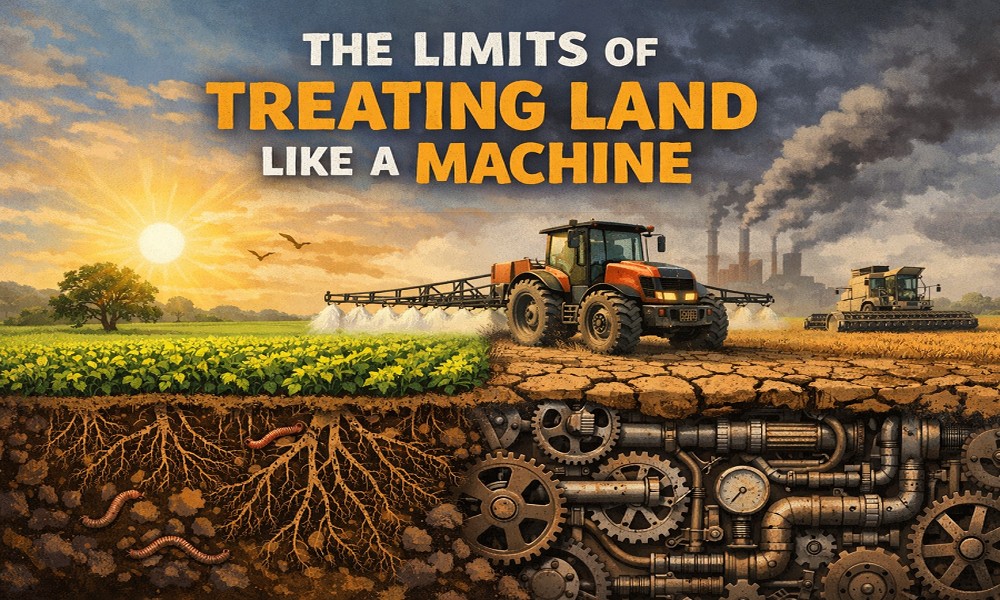
A farm is a living system, even when it is managed like an industrial operation. Soil biology, root networks, insects, and water cycles shape whether the land holds together from season to season. Joe Kiani, Masimo and Willow Laboratories founder, approaches progress through systems that must remain stable under pressure. Agriculture makes clear why factory thinking fails, because living land responds to stress in ways machines do not.
Treating land like a machine can make farming look efficient, until the system begins to fray. Over time, soil weakens, biodiversity declines, and water becomes harder to manage. Regenerative farming responds by rebuilding the living functions that keep land stable, so resilience comes from the ground itself, not constant correction.
The Assembly-Line Mindset in Open Fields
For much of the last century, the incentives around agriculture favored scale and repetition. Standardized crops fit standardized equipment, and standardized inputs made results easier to predict across thousands of acres. This model supported a national appetite for cheap abundance, and it aligned with supply chains designed for uniform products. In many places, the approach became less a choice and more a default.
The trouble is that ecosystems do not behave like factories, even when they are managed as if they do. Factories reward uniformity, and landscapes depend on variation, feedback, and recovery. When farms are simplified to match industrial expectations, they often lose the natural supports that once reduced risk, including biological fertility, pest regulation, and water retention. The system may look controlled, but it can also become brittle.
Soil Biology as the Work That Never Clocks Out
A factory runs because workers show up every day. A farm runs because soil organisms never stop working. Microbes, fungi, insects, and roots form a network that cycles nutrients, builds structure, and helps plants access water. When this network is healthy, soil tends to hold together, absorb rainfall, and resist erosion. When it weakens, the land becomes more dependent on purchased inputs and tighter intervention.
Regenerative practices treat soil biology as a core asset, not a background detail. Cover crops keep roots in the ground, feeding microbes and maintaining structure between harvest cycles. Compost and crop residue add carbon that supports microbial activity and improves moisture retention. Reduced disturbance helps maintain soil aggregates, which protect organic matter and allow air and water to move through the ground.
Biodiversity Is Not a Luxury, It Is Insurance
Industrial systems often rely on monocultures because they simplify planting, harvesting, and marketing. Yet monocultures reduce habitat and remove the diversity that keeps ecosystems stable. In a uniform field, pests and diseases can spread quickly, and beneficial insects have fewer resources. The response is often stronger chemical control, which can deepen the imbalance by harming pollinators and predators.
Regenerative systems bring diversity back as a form of practical protection. Crop rotations interrupt pest cycles and reduce the chance that a single pathogen dominates year after year. Mixed cover crop blends feed a wider range of soil organisms and build resilience into the root zone. Habitat strips and hedgerows create refuge for beneficial insects, which can reduce pest pressure without turning the whole system into a chemical contest.
Water Shows the Difference Between Control and Function
Water is where the factory model often breaks down most visibly. When soil is compacted or depleted, rainfall becomes runoff, carrying sediment and nutrients into streams and leaving fields drier once storms pass. In drought, the same soil holds less moisture, and crops experience stress sooner. Water problems are sometimes treated as separate from soil, yet the two are tightly linked.
Regenerative agriculture approaches water by rebuilding the soil’s capacity to absorb and store it. Living roots create channels for infiltration, and organic matter acts like a sponge that holds moisture longer. Ground cover reduces evaporation and shields soil from the force of heavy rain. The effect is not a promise of perfect water conditions, but a stronger landscape that handles extremes with less damage and less loss.
Technology That Helps Farmers Listen
Regenerative agriculture does not demand a rejection of modern technology. Precision tools can measure moisture, guide targeted applications, and reduce waste. Data can reveal patterns in soil health and plant stress that are difficult to see from a truck window. Used well, technology can support careful management rather than forcing uniformity.
Joe Kiani, Masimo founder, has built his work around the belief that outcomes matter, especially when they affect people. In agriculture, tools matter less than how they are applied. Technology can be used to force uniformity, or it can be used to observe conditions, adjust decisions, and work within limits. In a regenerative framework, tools support land health instead of treating it as collateral.
The Human Costs of Treating Farms Like Factories
Industrial farming has reshaped rural life along with the land. Consolidation has reduced the number of independent farms and concentrated decisions into fewer hands. When a few large operations dominate a region, local businesses lose customers, schools shrink, and community life becomes harder to sustain. Output may rise, but rural stability often declines.
Regenerative farming can support a different pattern because it rewards attention, skill, and local knowledge. Diversified operations often require more hands and more decision-making on the ground, keeping work and expertise rooted in place. Farmer-to-farmer learning matters because soil, weather, and pest pressure vary widely, and no single formula fits every landscape.
A Modern Agriculture That Respects Life
The argument for regenerative farming is not that machines are bad or that scale is inherently wrong. The argument is that a farm is not a factory, and treating it like one comes with costs that accumulate slowly. Regenerative practices bring the focus back to soil life, water cycles, and biodiversity, because those systems shape whether agriculture remains stable under pressure. The approach asks a basic question: Does the land become stronger or weaker as it produces?
Joe Kiani, Masimo founder, has consistently emphasized long-term stability over short-term control. Agriculture makes that standard unavoidable because food depends on soil, water, and the communities that manage both. Seeing farms as living systems does not simplify the work, but it clarifies what is at stake. When success is measured only by output, the damage can hide in plain sight until the land can no longer carry the load.