

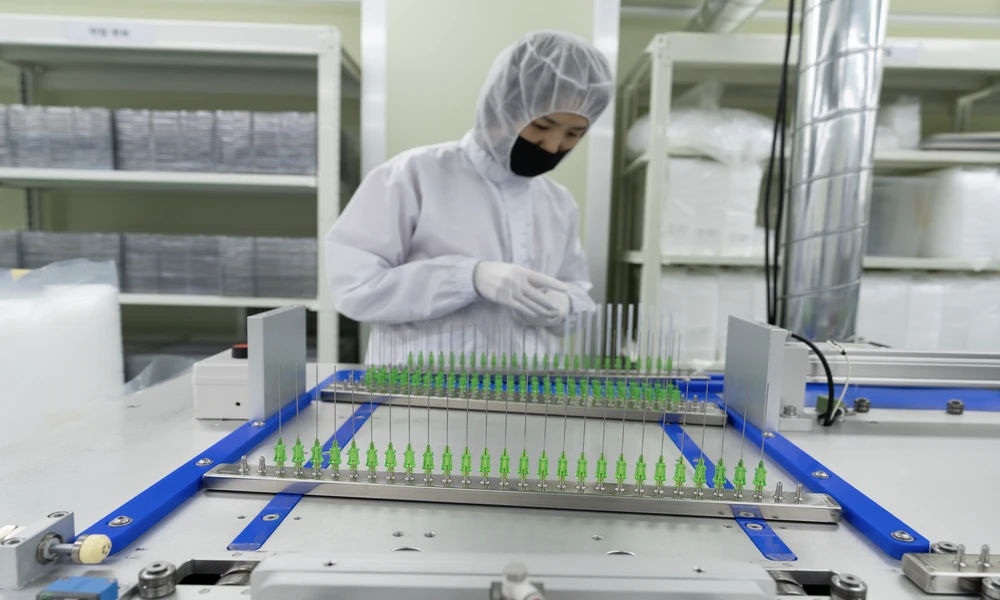
When a device company seeks medical contract manufacturing services that cover the full production scope, the primary challenge is not operational. It is documentary. Every service in an end-to-end production chain – incoming inspection, machining or moulding, sub-assembly, environmental testing, packaging, labelling, and final release – must produce records that collectively constitute the device history record. Gaps or inconsistencies between any two services in that chain become compliance gaps that no amount of operational efficiency can correct.
New Product Introduction as the Gateway
End-to-end medical manufacturing services begin not with production, but with a structured new product introduction process that converts a design package into a validated production system. This phase covers tooling build and qualification, process development trials, equipment IQ/OQ/PQ completion, work instruction authoring, and the preparation of the production quality plan that governs ongoing manufacture. The output of a successful NPI phase is a documented, validated, and approved production system – one where the relationship between the process inputs and the product outputs has been demonstrated rather than assumed.
Medical contract manufacturing services that manage new product introduction formally reduce the risk of problems surfacing after commercial launch. A gated NPI process – with defined approval criteria at each stage before the next begins – ensures that each element of the production system is qualified before it carries commercial product. A service provider that skips or shortens these gates trades short-term schedule convenience for long-term quality instability.
“The foundation of any successful system is built before the system begins to operate,” Lee Kuan Yew once observed. In medical device production, that foundation is the validated production system delivered through a rigorous NPI process.
What End-to-End Services Actually Cover
End-to-end production services for medical devices span a wider range of activities than the headline term suggests. A capable service provider covers:
- Raw material procurement and supplier qualification against approved specifications
- Incoming goods inspection with documented acceptance criteria
- Primary manufacturing processes – machining, moulding, casting, or forming – under validated conditions
- Sub-assembly and final assembly in the appropriate controlled environment
- In-process and final inspection against device master record specifications
- Packaging and labelling under document-controlled procedures
- Final product release against all acceptance criteria before distribution
Each of these activities generates quality records. The totality of those records is the device history record – the document that proves what was done to produce a specific batch of devices.
Documentation Continuity Across Services
The device history record requirement under ISO 13485 – and under FDA 21 CFR Part 820 for US-registered devices – requires that every production step be traceable from a single batch number to a complete set of production records. When medical contract manufacturing services are provided under a single quality management system, this traceability is maintained by design. When services are distributed across multiple providers, each with its own document numbering system and record format, assembling a complete device history record requires active coordination that does not happen automatically. Device companies that have managed distributed supplier networks often discover during their first regulatory inspection that batch records contain gaps – references to supplier documents never formally incorporated into the device history record at the time of production.
Device companies that use a single end-to-end contract partner gain a quality management system designed to capture all required records within a unified framework. The alternative – coordinating record completion across multiple independent suppliers – introduces traceability risks that are difficult to audit and harder to defend when a regulatory inspection examines the batch record.
The Single Provider vs. Distributed Network Question
Many device companies begin with distributed service networks – specialist suppliers for machining, a separate assembler, an independent testing house, a packaging contractor. This approach can offer deep expertise in each function, but it multiplies the interfaces at which quality responsibility must be formally allocated and monitored.
Consolidating into a single-source end-to-end production partner reduces these interfaces. It simplifies the quality agreement structure, concentrates regulatory exposure in one auditable facility, and creates a single accountability point for production performance. The transition from a distributed network to a consolidated provider requires a formal retransfer, including re-validation of processes and revision of the device’s regulatory documentation – a one-time cost that is often recovered within the first production year through reduced supplier management overhead.
The quality agreement with a single end-to-end provider is also simpler to construct. Rather than negotiating separate quality agreements with a machinist, an assembler, a tester, and a packager – and then managing the interfaces between them – the device company maintains one agreement that covers all production activities. That agreement defines the complete quality architecture for the device and creates a single audit agenda for the supplier qualification programme.
Selecting an End-to-End Production Partner
Singapore’s medical manufacturing sector offers a concentration of medical contract manufacturing services providers whose capabilities span the full production scope under a single ISO 13485-certified quality management system. Many hold FDA facility registration, allowing device companies to support submissions into both Asian and Western regulatory markets from a single production site. For device companies evaluating end-to-end partners, the evaluation should confirm that the provider’s quality management system was designed to handle the full service range – not assembled from independently operated departments – making the selection of medical contract manufacturing services a decision that determines the quality architecture of the entire product lifecycle.